
Blog
NICE Draft Guidance on Prostate MRI AI: What It Means for NHS Services
On October 23, 2026, the National Institute for Health and Care Excellence (NICE) published draft guidance proposing that five artificial intelligence (AI) technologies, including ProstatID® from Bot Image™, Inc., be used as options to support radiologists interpreting prostate MRI scans in the NHS in England.
The proposal would allow eligible technologies to be used during a two-year evidence-generation period, subject to regulatory and NHS requirements and the collection of further clinical evidence.
The recommendations remain provisional. Public consultation closes on November 12, 2026, and NICE may revise its recommendations before issuing final guidance.
For NHS imaging services, the development signals growing interest in AI-assisted prostate MRI interpretation while acknowledging that important questions about clinical performance, patient outcomes and workflow remain unanswered.
What NICE’s Draft Guidance Proposes
NICE assessed seven AI technologies designed to assist healthcare professionals in identifying suspicious findings on prostate MRI.
Its committee proposed five technologies for conditional NHS use: AI-Rad Companion Prostate MR, DeepHealth Prostate, ProstatID, Prostate Intelligence and QP-Prostate.
Two requirements must be met: the evidence specified in NICE’s evidence-generation plan must be collected, and each technology must have appropriate regulatory authorization, including meeting NHS England’s Digital Technology Assessment Criteria (DTAC) requirements.
This is an early-use recommendation, intended to support further evaluation in clinical practice. It does not establish that the five technologies offer equivalent performance or that their potential clinical benefits have been conclusively demonstrated.
Why NICE Is Evaluating AI for Prostate MRI
Prostate cancer remains a major diagnostic challenge for the NHS. England recorded 58,137 new prostate cancer diagnoses in 2023, according to figures cited in NICE’s assessment.
NICE guideline NG131 recommends multiparametric MRI (mpMRI) as the first-line investigation for suspected clinically localized prostate cancer, with results reported using a five-point Likert scale.
The increased use of MRI before biopsy has placed additional demands on radiology services, particularly where access to specialist uroradiologists is limited.
AI technologies could potentially help by highlighting suspicious regions, supporting lesion assessment and improving consistency between readers. However, their contribution must be evaluated against the accuracy of conventional radiologist interpretation and the consequences for subsequent clinical decisions.
What the Evidence Shows and Where Uncertainty Remains
NICE reviewed 20 clinical studies covering five technologies, primarily examining diagnostic accuracy when AI was used alongside healthcare professionals.
The evidence was limited and heterogeneous. Most studies were conducted outside the UK, and all but one were assessed as having a moderate to high risk of bias. Differences in patient populations, reference standards, study methods and radiologist experience complicated comparisons.
The review included one study evaluating ProstatID.
NICE concluded that the five technologies with supporting evidence could potentially improve radiologist accuracy in detecting clinically significant prostate cancer. However, findings were not consistently favorable across studies or technologies.
Evidence of operational benefit was also limited. Studies assessing reading time for three technologies—AI-Rad Companion Prostate MR, DeepHealth Prostate and QP-Prostate—did not demonstrate a meaningful reduction in MRI interpretation time. Equivalent reading-time evidence was not available for ProstatID in NICE’s review.
The committee reported no evidence that AI-assisted prostate MRI interpretation had caused patient harm in the studies considered. Nevertheless, it identified potential risks involving missed lesions and incidental findings. Radiologists must continue to review the complete examination and remain responsible for clinical interpretation.
NICE is therefore seeking further evidence on diagnostic accuracy with and without AI, biopsy decisions, time to diagnosis, patient outcomes and radiology workflow. It also wants to understand performance across different patient populations, particularly people from Black African and Caribbean backgrounds, and across MRI scanner models and acquisition protocols.
How ProstatID Supports Radiologist Interpretation
ProstatID is AI-assisted computer-aided detection and diagnostic support software developed by Bot Image™, Inc. to assist trained radiologists reviewing prostate MRI examinations.
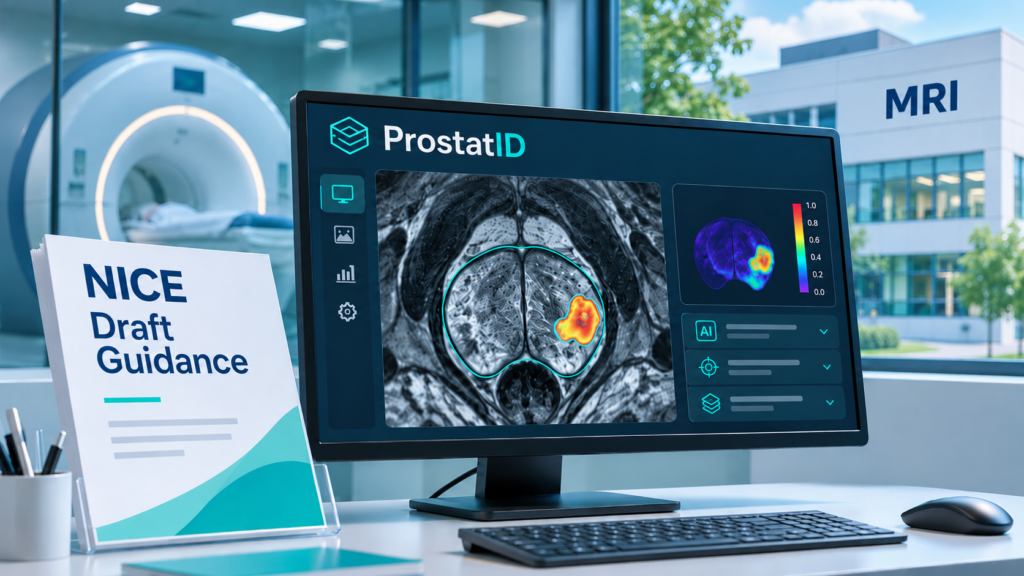
The software analyses T2-weighted (T2W), diffusion-weighted imaging (DWI) and apparent diffusion coefficient (ADC) sequences to identify and segment suspicious lesions. It generates color-coded overlays, lesion probability assessments and suggested Prostate Imaging Reporting and Data System (PI-RADS) scores, together with annotated imaging and report outputs.
These results are intended to support radiologist interpretation alongside the original MRI images and relevant clinical information. The radiologist remains responsible for the final assessment.
ProstatID can process the relevant sequences from non-contrast biparametric MRI (bpMRI) as well as mpMRI examinations, subject to the applicable product specifications and intended use.
This compatibility is particularly relevant as imaging services investigate the potential role of shorter, non-contrast MRI protocols. However, NICE found no direct evidence comparing AI-assisted bpMRI interpretation with unassisted mpMRI interpretation. Technical compatibility therefore does not establish that AI-assisted bpMRI can replace mpMRI in routine clinical practice.
ProstatID also provides suggested PI-RADS assessments. These must be considered within local reporting practices, including the five-point Likert system recommended in NICE NG131.
In supported picture archiving and communication system (PACS) workflows, Bot Image reports typical software processing turnaround of less than five minutes. This refers to processing and returning the AI outputs, not radiologist reading time or a demonstrated improvement in clinical throughput.
What Happens Next for NHS Imaging Services
NICE’s proposed approach would allow eligible technologies to be paid for through core NHS funding during the two-year evidence-generation period. Manufacturers would be responsible for organizing funding for the required evidence-generation activities.
For NHS organizations considering adoption, this creates an opportunity to evaluate AI-assisted prostate MRI in routine practice while collecting evidence on clinical performance, workflow and patient outcomes.
Implementation will still require attention to regulatory compliance, information governance, technical integration, radiologist training and the collection of appropriate clinical data.
NICE also advises NHS organizations to consider the provisional nature of the recommendations when negotiating contracts and licensing arrangements. At the end of the evidence-generation period, the guidance will be reviewed, and recommendations may change.
For radiology services, the important question is whether AI assistance can deliver measurable improvements in diagnostic accuracy, consistency and patient care across the diversity of NHS practice.
NICE’s draft guidance establishes a proposed framework for answering that question through real-world evidence.
The consultation and supporting information are available through NICE. NHS organizations interested in learning more about ProstatID’s technical capabilities and clinical evidence can also contact Bot Image.
Sources
NICE. Artificial intelligence technologies to help detect prostate cancer on MRI: early-use assessment. HealthTech draft guidance, GID-HTG10879, October 2026.
NICE. AI could help spot prostate cancer more accurately, says NICE. News announcement, 23 October 2026.
NICE. Prostate cancer: diagnosis and management, NG131. Published 9 May 2019; last updated 15 December 2021.
Pioneering Cancer Detection with AI and MRI (and CT)
At Bot Image™ AI, we’re on a mission to revolutionize medical imaging through cutting-edge artificial intelligence technology.
Contact Us